A1.1.1
Describe the functions and interactions of the main CPU components
The CPU is the primary computational (计算的) engine of the computer, responsible for executing instructions.
CPU
- A hardware component (组成部分) that performs:
- Arithmetic (算数, 计算)
- Logical or input/output operations, to process data from input devices into useful information.
Block Diagram of CPU
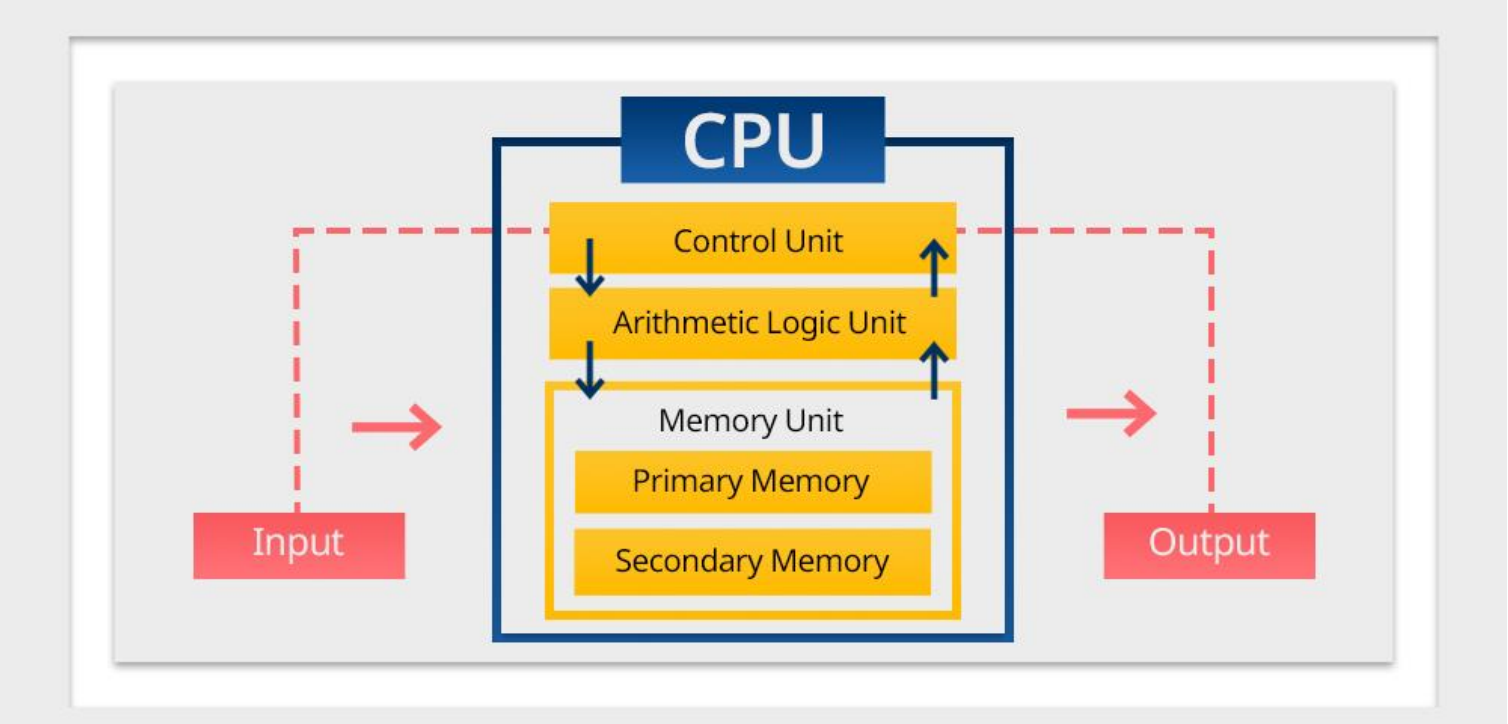
Key Components of CPU
A component is a distinct functional unit within the CPU with a specific role in the processor’s operation.
- Control Unit (CU)
- Arithmetic Logic Unit (ALU)
- Registers (寄存器): IR, PC, MAR, MDR, CIR, AC
- Cache (高速缓存): L1, L2, L3
- Buses (总线): Control Bus, Data Bus, Address Bus
Control Unit
- Orchestrates the fetch-decode-execute cycle.
- Decodes/interprets instructions fetched from memory and generates control signals to activate hardware units within the CPU.
- Involves parsing (解析) the instruction’s opcode, which determines the specific action (read/write data, compute, test logic).
Arithmetic Logic Unit (ALU) 算数逻辑单元
- Performs arithmetic and logical operations — where actual computation happens (addition, subtraction, AND, OR, NOT, etc.).
- Works with the Accumulator (ACC) or general-purpose registers to store results.
- Receives control signals from the CU telling it which operation to do.
Registers 寄存器
A small-capacity, very fast storage location within the CPU, used to store data temporarily during program execution. Holds instructions, storage addresses, or data.
- PC (Program Counter): Holds the address of the next instruction. Incremented automatically (most commonly at the end of fetch). 指向了 CPU 接下来要从主内存 (RAM) 中取出的那条指令。
- IR (Instruction Register): Holds the current instruction being executed. Temporary holding area before decode/execute.
- MAR (Memory Address Register):
- Stores the memory address where the next data/instruction is to be found or stored.
- Can also hold a destination address for processed data.
- Connects to primary memory via the Address Bus.
- MDR (Memory Data Register):
- Holds data or instructions being transferred to/from primary memory.
- Works with MAR: the MAR address determines which data is loaded into MDR.
- After processing, the ALU places results into MDR, which is written to RAM at the MAR-specified address.
- The Data Bus transfers data between RAM and MDR.
- ACC (Accumulator): Special-purpose register storing intermediate operation results. Often used for arithmetic/logical operations. ALU’s专用 register.
Buses 总线
A shared communication pathway which transfers data between components within a computer.
- Control Bus
- Carries control signals (not data) from the CU to other components, managing actions and timing.
- Can be unidirectional or bidirectional.
- Handles read/write, interrupts, timing, acknowledgments.
- Data Bus
- Pathway for transferring actual data between CPU, memory, and other components.
- Width affects speed (e.g., 32-bit vs 64-bit).
- Bidirectional — store (CPU → component) or load (component → CPU).
- Address Bus
- Carries memory addresses from CPU to specify where data is read/written. (
where→ address) - Unidirectional — only CPU sends addresses to components.
- Carries memory addresses from CPU to specify where data is read/written. (
Types of CPU processors
Single-core processor
- Has one processing unit (core) in a single circuit. Reads and executes instructions from processes.
- Singular processing path — handles one instruction at a time (sequential execution).
- Standard in early CPUs and older computers, where task completion relied on linear instruction processing.
- Main limitation: poor at parallel processing demands. As tasks grow complex and multitasking becomes essential, single-core processors hit performance bottlenecks (瓶颈).
Multi-core processor
- A single chip containing two or more independent cores, each capable of executing instructions in parallel.
- Handles multiple instructions at once → significantly better performance than single-core, especially for multitasking and parallel tasks.
- Ideal for multitasking, gaming, and servers.
- Software must be specifically written to leverage multiple cores.
- Improves performance/efficiency by distributing workloads across cores (big task → sub-tasks → each completed by one core simultaneously).
Co-processor
- Specialized processors that supplement the main CPU, offloading (分流) specific tasks to optimize performance.
- Can be integrated into the CPU or exist as separate entities.
- Free the main CPU to focus on general processing.
- Examples: GPUs, audio processors, DSPs (Digital Signal Processors).
- Used for: graphics rendering, mathematical calculations, data encryption (加密).