A2.2.1
Describe the functions and practical applications of network topologies
Network topology is the arrangement of devices ( nodes ) and connections ( links ) in a network. Topology can be: physical topology the actual arrangement…
- Network topology is the arrangement of devices (nodes) and connections (links) in a network.
- Topology can be:
- physical topology
- the actual arrangement of cables, routers, switches, and hardware
- logical topology
- how data flows across the network, regardless of physical layout
- physical topology
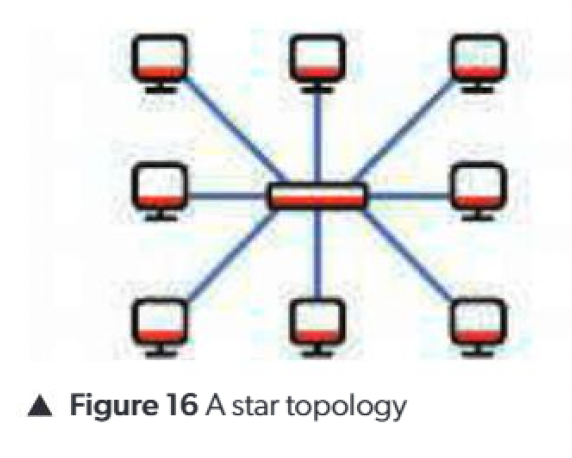
Star topology
- In a star topology, each device connects directly to a central device, usually:
- a switch
- a hub
- a router
- Characteristics
- all communication passes through the central device
- the network has a star-like shape
- Reliability
- reliability is generally high
- if one cable or one end device fails, the rest of the network usually continues working
- however, if the central device fails, the whole network may fail
- Transmission speed
- usually fast
- direct links between devices and the centre reduce delays
- modern switches also reduce collisions effectively
- Scalability
- good scalability
- adding or removing a device is relatively easy
- limited by the number of available ports on the central device
- Cost
- can be expensive
- each device needs its own dedicated connection to the centre
- Practical applications
- home networks with a router or wireless access point in the centre
- business LANs using central switches
- school and office networks where centralized management is needed
Bus topology
- In a bus topology, all devices are connected to a single main communication line called the backbone cable (主干电缆).
- Characteristics
- all devices share the same communication line
- data travels along the backbone
- terminators are needed at both ends to reduce signal reflection
- Reliability
- reliability is lower than star or mesh
- if the backbone cable fails, the whole network may fail
- faults can be harder to locate
- Transmission speed
- can be acceptable in small networks
- performance drops as more devices send data at the same time
- collisions are more likely because devices share one channel
- Scalability
- limited scalability
- adding more devices increases traffic and reduces performance
- Cost
- relatively low cost
- requires less cabling than star topology
- Practical applications
- small or simple networks
- older LAN designs
- environments where low cost is more important than performance
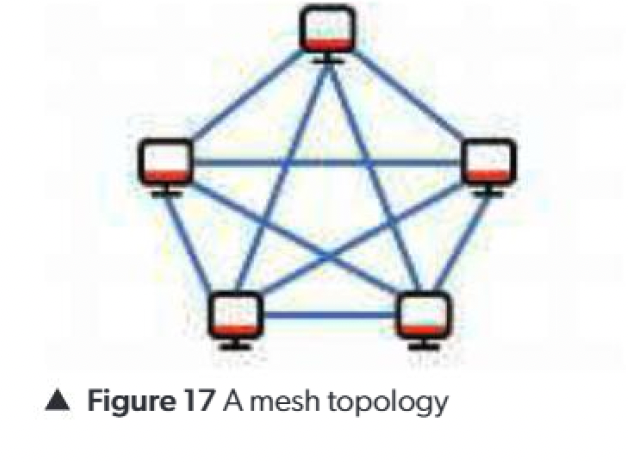
Mesh topology
- In a mesh topology, devices connect directly to many other devices.
- Types of mesh:
- full mesh
- every node connects to every other node
- partial mesh
- nodes connect to some, but not all, other nodes
- full mesh
- Reliability
- reliability is very high
- if one connection or node fails, data can often be rerouted through another path
- there is no single point of failure like a central switch
- Transmission speed
- can be fast because multiple paths are available
- however, speed depends on:
- number of hops
- traffic load
- connection quality
- Scalability
- can scale well in some wireless mesh systems
- in fully connected mesh networks, adding nodes may greatly increase complexity
- Data collisions
- collisions are uncommon
- intelligent routing and multiple paths reduce traffic conflicts
- Cost
- can be expensive, especially in full mesh systems
- more links and more sophisticated hardware may be required
- Practical applications
- modern Wi-Fi mesh systems in homes
- community mesh networks providing internet in areas with limited infrastructure
- manufacturing and warehousing systems where redundancy is important
- sensor networks and industrial networks requiring resilience
Ring topology
- In a ring topology, each device is connected to two other devices, forming a closed loop.
- Characteristics
- data travels around the ring from device to device
- each device acts as a link in the path
- Reliability
- reliability is moderate
- if one device or connection fails, the ring may be disrupted unless the network has redundancy
- Transmission speed
- can be efficient because data follows a structured path
- collisions can be reduced in controlled ring systems
- delay may increase as data passes through more nodes
- Scalability
- moderate scalability
- adding or removing devices may interrupt the network
- Cost and complexity
- more complex than bus
- usually less common in modern LAN design than star
- Practical applications
- token ring style networks
- specialized industrial or communication systems
- situations where controlled access is important
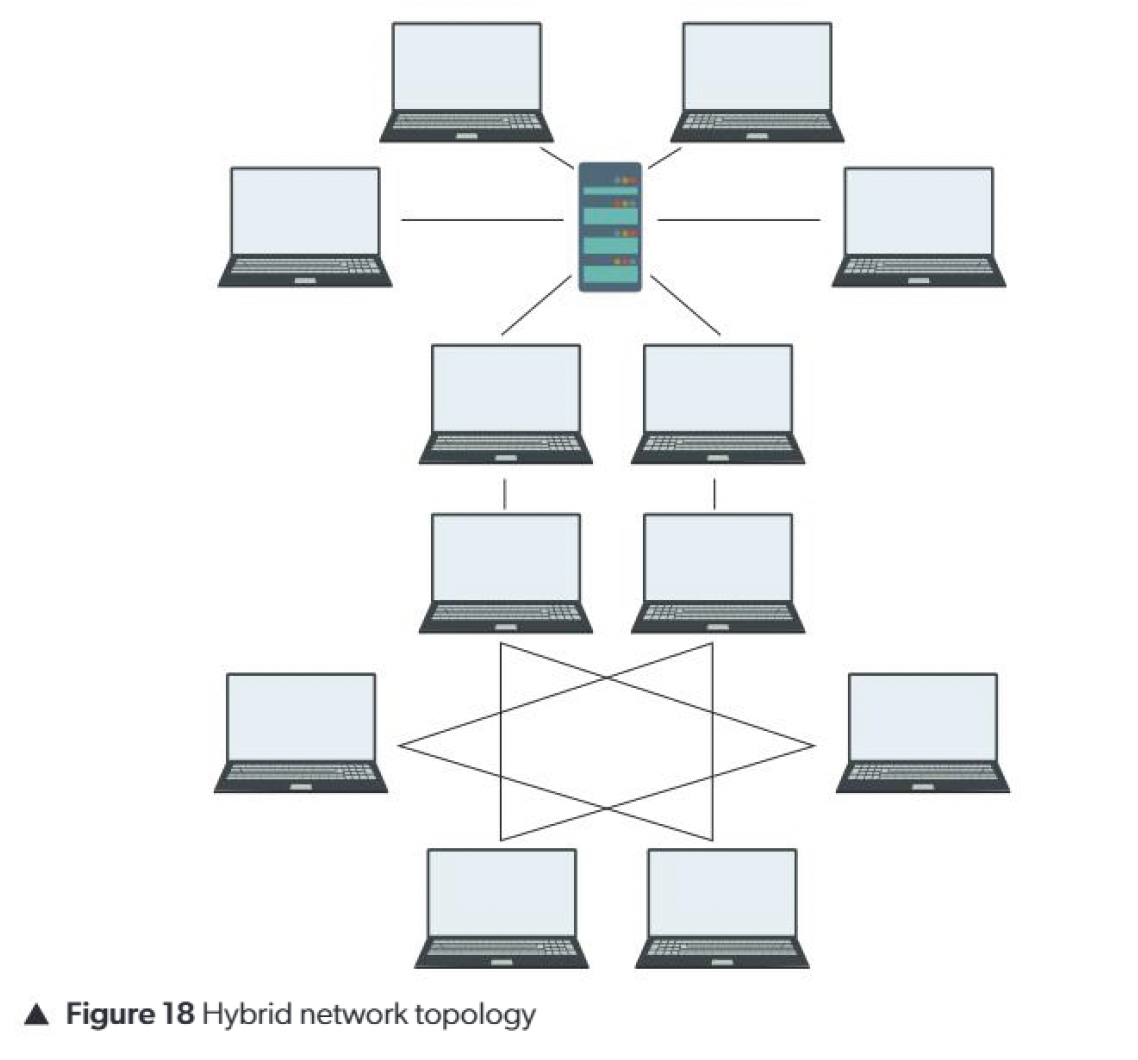
Hybrid topology
- A hybrid topology combines features of two or more different topologies.
- It is designed to take advantage of the strengths of each topology used.
- Characteristics
- can combine, for example:
- star + mesh
- star + bus
- star + ring
- different parts of the network can be designed for different needs
- can combine, for example:
- Reliability
- usually high
- reliability depends on the topologies being combined
- redundant paths from mesh-like sections can improve resilience
- centralized sections can still support control and management
- Transmission speed
- speed depends on the design
- direct connections in some sections may improve performance
- centralized sections may simplify traffic management
- Scalability
- usually flexible
- networks can be expanded by adding devices or segments in the most suitable topology
- Cost and complexity
- may be more complex to design and manage
- cost depends on the specific topologies and hardware involved
- Practical applications
- large organizations where different departments need different network structures
- enterprise networks with a star-based core and more redundant peripheral sections
- environments where both resilience and centralized control are needed
Quick comparison
| Topology | Advantages | Disadvantages | Common applications |
|---|---|---|---|
| Star | Fast, easy to manage, easy to expand, one device failure usually does not affect others | Central device is a single point of failure, more cabling needed | Home networks, offices, school LANs |
| Bus | Cheap, simple, uses less cabling | Backbone failure affects whole network, collisions, weak scalability | Small or older networks |
| Ring | Orderly transmission, can reduce collisions in controlled systems | A break can disrupt the network, harder to expand | Token ring and specialized systems |
| Mesh | Very reliable, redundant paths, strong fault tolerance | Expensive, complex, more links required | Mesh Wi-Fi, industrial and resilient networks |
| Hybrid | Flexible, combines strengths of multiple topologies | More complex to design and manage | Enterprise and large-scale networks |